
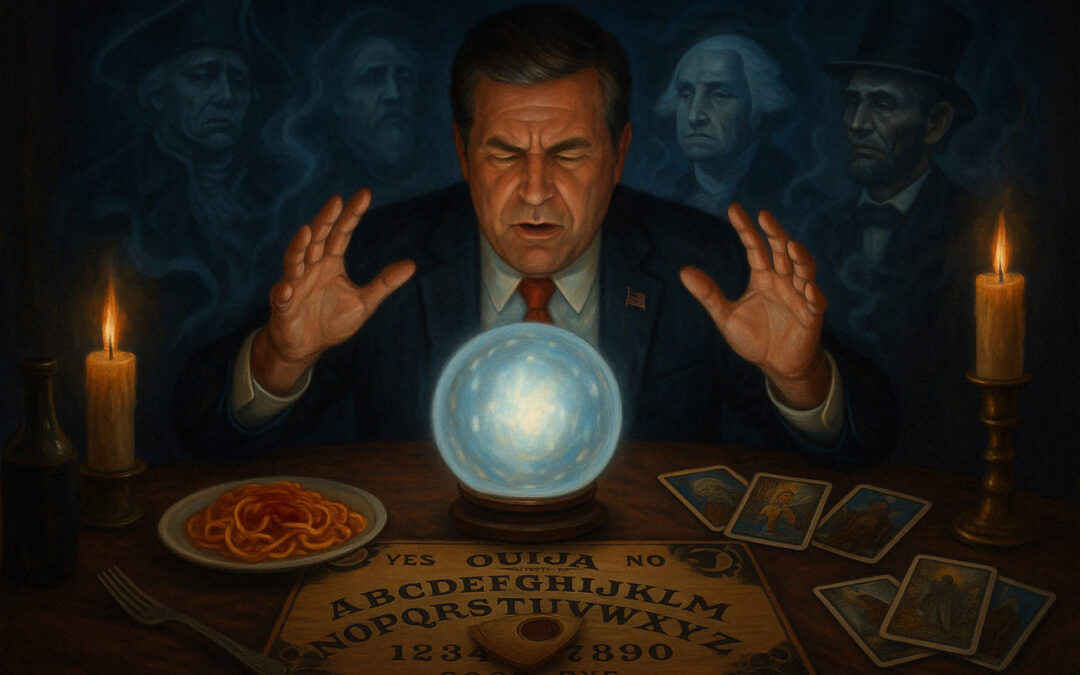
In the dimly lit world of mediumship, practitioners claim to communicate with the deceased, often using a technique called "cold reading." They toss out vague statements, closely watch audience reactions, and quickly pivot to whatever generates emotional responses. "I'm sensing someone with a J... John? James? A father figure?" When someone nods or gasps, the medium zeroes in, building an illusion of supernatural insight through careful observation and psychological manipulation.
Donald Trump's political ascendancy reflects a masterclass in applying these same techniques to political communication—a form of cold reading that helped propel him to the highest office in the land.
Trump's approach to political rallies bears striking similarities to a medium's performance. He tosses out themes—immigration, trade deals, political correctness—and carefully gauges audience reactions. When a particular line draws cheers ("We're going to build a wall"), he amplifies it, repeats it, and makes it a centerpiece of his messaging. When something falls flat, he quickly pivots elsewhere, rarely acknowledging the detour.
"Trump has an uncanny ability to read a room," notes political communication expert Dr. Miranda Chen. "He'll start with broad statements, watch which ones resonate, then drill down specifically on those topics. It's remarkably similar to how mediums operate—fishing for reactions, then claiming they knew all along."
Like mediums who tap into grief and longing, Trump's political appeal largely stems from his ability to connect with a sense of loss—the "dead" American Dream that many of his followers believe has disappeared.
"Remember when America was great?" he asks nostalgically, inviting his audience to project their own version of this lost greatness onto his vague canvas. For some, it's manufacturing jobs; for others, cultural dominance; for still others, a time when certain social hierarchies remained unquestioned.
This technique mirrors how mediums speak to those grieving loved ones—providing just enough specificity to seem authentic while leaving sufficient ambiguity for the audience to fill in the blanks with their own desires and memories.
Another technique shared by mediums and Trump's political approach is the validation of feelings that audiences had previously kept private.
"I'm sensing resentment... you've been overlooked, haven't you?" a medium might say. Similarly, Trump validates feelings that many supporters had previously felt unable to express publicly: resentment toward elites, frustration with changing social norms, anxiety about demographic shifts.
"You know what? It's OK to say it," became an implicit theme of Trump's rhetoric, giving permission to voice previously taboo sentiments. Like someone relieved that a medium has "connected" with their deceased relative, many supporters felt a profound sense of validation upon hearing their private frustrations acknowledged on a national stage.
Successful mediums closely monitor which statements generate emotional responses, then double down on those themes. Trump employs the same technique, noticing which lines receive the strongest reactions and incorporating them into his permanent repertoire.
The infamous "Lock her up" chant wasn't planned by campaign strategists—it emerged organically at rallies and, once Trump observed its powerful effect, became a campaign fixture. This creates a feedback loop: supporters feel increasingly seen and understood as their reactions shape the message, further strengthening their connection to the messenger.
Perhaps the most powerful parallel between mediumship and Trump's communication style is the creation of an illusion of direct, unfiltered connection. Both mediums and Trump position themselves as conduits speaking directly to their audiences without establishment intermediaries.
"I don't need the media," Trump frequently claims, just as mediums insist they don't need organized religion to connect people with the spiritual realm. This positioning as an unmediated truth-teller creates a powerful bond between speaker and audience, one that remains resilient against fact-checking or criticism from traditional authorities.
The effectiveness of these techniques transcends traditional political boundaries. Trump's rallies don't function merely as political events but as emotional experiences where participants feel deeply seen and understood. The validation of previously unspoken feelings creates intense loyalty that often defies conventional political analysis.
"What many critics miss," explains sociologist Dr. James Barrett, "is that supporters aren't necessarily responding to policy positions but to the emotional experience of finally feeling heard. It's similar to why people continue visiting mediums even when skeptics point out the techniques being used—the emotional validation outweighs rational critique."
Trump's rise represents more than just one politician's success—it signals a fundamental shift in political communication, prioritizing emotional resonance over policy detail, validation over verification.
As we move forward, voters across the political spectrum would benefit from recognizing these techniques. Understanding the mechanisms of political cold reading doesn't diminish its emotional power, but it does provide citizens with tools to distinguish between genuine leadership and skilled performance.
The most effective counter isn't simply fact-checking but offering an equally compelling emotional narrative that acknowledges people's genuine concerns while channeling them toward constructive rather than divisive ends.
After all, mediums remain popular not because people are gullible, but because they address deep human needs for connection, meaning, and validation. Any political movement hoping to counter these techniques must recognize and address these same fundamental needs—not through cold reading, but through authentic connection.